

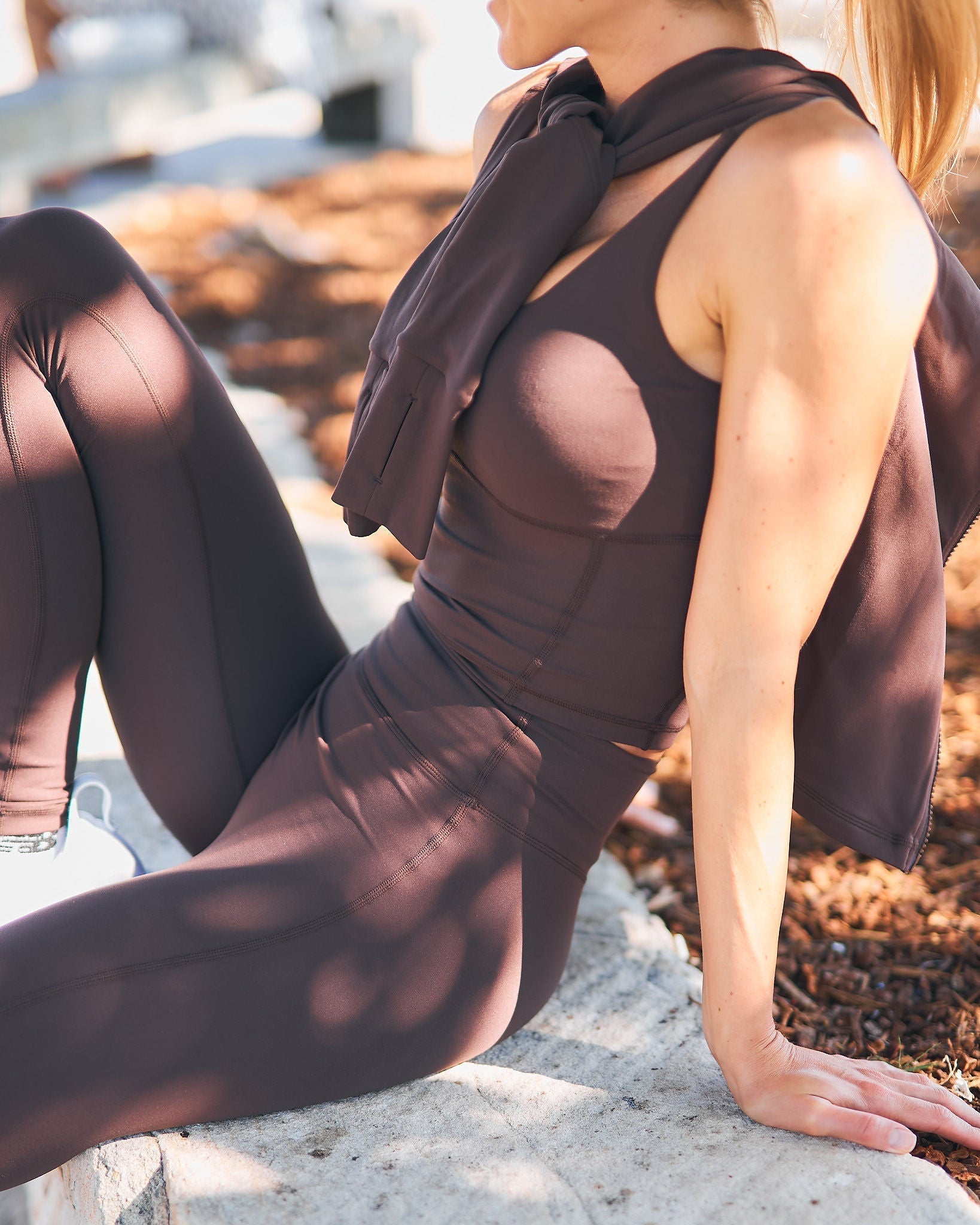
Flare leggings work for Pilates, yoga, walking, dance, and barre. They fail for running, HIIT, weightlifting, and Australian summer heat. If you want one pair of leggings for actual training, high-waisted wins. If you want a pair built for low-impact movement and everyday wear, flares earn the spot. Here's the honest comparison and how to choose between the two for the way you actually train.
Flare leggings are everywhere in 2026. Hailey Bieber wears them to Pilates. Wide-leg jeans replaced skinny jeans, and activewear followed. The pilates-and-iced-matcha aesthetic put the silhouette back on every algorithm. The question worth asking before you buy: do they actually work for the way you train?
Why are flare leggings trending in 2026?
The flare comeback is a fashion cycle that came due, not a marketing invention. After a decade of ankle-hugging leggings, the eye wanted something different.
Vogue documents the cultural moment — Hailey Bieber wearing Alo Yoga flares to a Pilates class, Emily Ratajkowski wearing them for weekend errands. From there the silhouette spread. Industry trend forecasts back it up. Bootcut and slightly flared leggings are listed as a major 2026 retro silhouette alongside warm neutrals and layered sports bras.
So flares are trending. That doesn't mean they're right for every workout. The harder question is what they were actually engineered for.
When do flare leggings actually work?
Flares are well-built for low-impact, leg-mobile training. The construction logic is simple: fitted through the hip and thigh for compression, then a kick from the knee or mid-calf for room to move.
The activities they suit:
- Pilates and yoga. The hem doesn't bunch in a deep stretch. The line down the leg lengthens visually in the mirror, which matters more than people pretend.
- Walking and the post-Pilates errand. Flares read as athleisure, not as gym kit. You can wear them to brunch without looking like you came from a gym floor.
- Dance, barre, and anything leg-mobile. The flared hem gives your calves and ankles breathing room.
- Lounging. Honest answer: most of us wear activewear for non-active hours. Flares are more comfortable on the couch than tight ankle leggings.
The Yahoo Shopping 2026 review of flare leggings puts it cleanly: they're best for yoga, Pilates, walking and lower-impact movements where they don't get in the way.
That's the honest case for flares. It's a good one. The trap is when you try to make them do more.

When do flare leggings fail?
The flared hem becomes a liability the second you move at speed or load weight. This is the part flare-leggings articles tend to skip.
Running. Gymshark's own running-leggings guide flags it directly — flared leggings can trip you up. The hem catches your stride. It also flaps against the calf in a way that breaks rhythm. Running leggings exist as a separate category for a reason. They're cut close from knee to ankle to disappear when you move.
HIIT and bootcamp. Box jumps, burpees, plyo work. The hem snags on shoes. The wider ankle opening lets a phone fall out of a side pocket. Anything explosive needs leggings that move with the leg, not around it.
Weightlifting and equipment work. The Yahoo review is blunt: avoid flares for workouts using equipment that may snag. A barbell catching on flare fabric mid-squat is not a problem you want.
Australian summers. Wider hems mean more fabric. More fabric means more heat. For Sydney in February, this matters.
There's also a quieter problem. The flared hem requires more fabric overall, which means manufacturers often pull back on compression to keep cost down. The result: flares that look the part but offer less support than the high-waisted equivalent of the same brand.
Flare vs high-waisted leggings: head to head
The clearest way to see the trade-off is side by side. Across the criteria that matter for actual training, high-waisted wins more often than not — but the flare wins where it matters for low-impact movement and everyday style.
| Criteria | Flare leggings | High-waisted leggings |
|---|---|---|
| Best for | Pilates, yoga, walking, dance, barre | Lifting, running, HIIT, daily training |
| Waistband stays put | Less reliable — fabric drag pulls the band down | Yes, designed to lock against the natural waist |
| Squat-proof opacity | Often weaker — manufacturers cut cost on fabric density | Consistent — built dense from waist to ankle |
| Compression | Lighter through the leg | Concentrated through core and glutes |
| Everyday-outfit factor | Strong — reads as athleisure, not gym kit | Good but reads more "gym" |
| Australian summer heat | More fabric, hotter | Less fabric, cooler |
What high-waisted leggings give you that flares can't
Three things, and all three matter for actual training: a waistband that stays put, compression where you need it, and squat-proof opacity from top to bottom.
A waistband that stays put. Yvette Sports breaks the engineering down well — the dreaded sag is the single biggest reason women hate their leggings. A proper high-waisted band, wide and well-built, locks against the natural waist and doesn't slide during deep squats or sprints. Flares can be high-waisted too, but the bigger fabric volume below creates downward drag the waistband has to fight.
Compression where you need it. High-waisted leggings concentrate the support across the core and glutes. You feel anchored through a lift or a sprint. Flares are usually lighter through the leg by design, which trades support for room to move.
Squat-proof opacity, top to bottom. A good high-waisted legging is knitted dense enough to stay opaque at the bottom of a squat. Cheaper flares pill or thin first at the calf hem, which is the part everyone sees from behind.
The honest summary: high-waisted is built for the workout. Flares are built for the look around the workout.

How do you choose between flare and high-waisted leggings?
The practical framework, no padding.
Train most days? High-waisted, every time. The compression, the stay-put waistband, the squat-proof fabric — these are non-negotiable for real training.
Pilates and yoga focus? Flares are the better tool. The room to move and the line down the leg actually work in your favour.
Mixed week — some lifting, some Pilates, some walking? Buy high-waisted as the working pair, flares as the second pair. Most women don't need three pairs of activewear leggings. Two is enough if both are bought well.
Activewear-as-everyday clothes? Flares win. They read less gym and more outfit.
The trap to avoid: buying flares thinking they'll do everything and being disappointed when they roll down on the treadmill. They were never designed to.
The Womene take
Womene makes high-waisted. The Moments range is built for the woman who trains and lives in her activewear — not for the woman who needs a different pair for every aesthetic.
Womene's Moments leggings use a buttersoft nylon-elastic blend with four-way stretch and a weighty hand feel against the skin. The waistband sits at the natural waist and stays put through a squat. Sizes 2 to 2XL across the range, same fabric, same fit logic. Designed in Sydney for the way Australian women actually train.
Womene doesn't make flares yet. We may, eventually. For now we'd rather make one piece well than five pieces averagely. That's how the brand was built.
If you train and want a legging that handles strength, intervals, walking and weekends without trade-offs, Womene's Moments high-waisted is the pair we'd point you to. If you want flares, buy them from someone who does them well. Alo Yoga and Beyond Yoga both make strong pairs. Honest is honest.
Buttersoft, supportive, real.
Frequently asked questions
Are flare leggings good for working out?
Flare leggings are good for low-impact workouts where the hem doesn't get in the way — Pilates, yoga, barre, dance, and walking. They are not suited to running, HIIT, weightlifting, or any explosive movement where the flared hem can catch on shoes or equipment. For mixed training, high-waisted leggings are the more reliable choice.
Can you wear flare leggings for running?
No, flare leggings are not recommended for running. The flared hem catches your stride and flaps against the calf in a way that breaks rhythm. Gymshark's own running-leggings guide flags this directly. Running leggings are deliberately cut close from knee to ankle so the fabric disappears when you move.
What's the difference between flare leggings and high-waisted leggings?
Flare leggings are defined by their silhouette — fitted through the hip and thigh, then flared from the knee or mid-calf. High-waisted leggings are defined by their waistband — sitting at the natural waist with structured support. The two are not mutually exclusive (a legging can be both flared and high-waisted), but high-waisted is built for training while flares are built for the look around the workout.
Why do flare leggings sometimes feel less supportive than regular leggings?
The flared hem requires more fabric overall, so manufacturers often reduce compression and fabric density in the leg to keep production cost down. The result is a legging that looks the part visually but offers less support than the high-waisted equivalent from the same brand. The fabric also tends to pill first at the calf hem, which is the part everyone sees from behind.
Are flare leggings still in style in 2026?
Yes. Flare and bootcut leggings are listed by industry trend forecasts as one of the major 2026 activewear silhouettes, alongside warm neutrals and layered sports bras. The trend is driven by the broader return of wide-leg shapes in fashion and the visibility of the silhouette on figures like Hailey Bieber and Emily Ratajkowski.
What's the best length of legging for Pilates?
For Pilates, the best length is one that gives you a clear visual line down the leg without bunching in deep stretches. Both full-length flares and full-length high-waisted leggings work. 7/8 lengths also work well for reformer Pilates because the ankle is left clear for footwork. The fabric should be opaque enough to stay squat-proof through every position.
Should I buy flares or high-waisted leggings?
Buy high-waisted if you train most days, mix strength with cardio, or want one pair that handles everything. Buy flares if your training is mostly Pilates, yoga, or walking, or if you wear activewear as everyday clothes more than for the gym. If you can buy both, get high-waisted as your working pair and flares as your second pair.
Share:
Will My Breasts Sag If I Don’t Wear a Bra During Pregnancy?
HIGH WAISTED GYM LEGGINGS: THE AUSTRALIAN BUYER'S GUIDE